
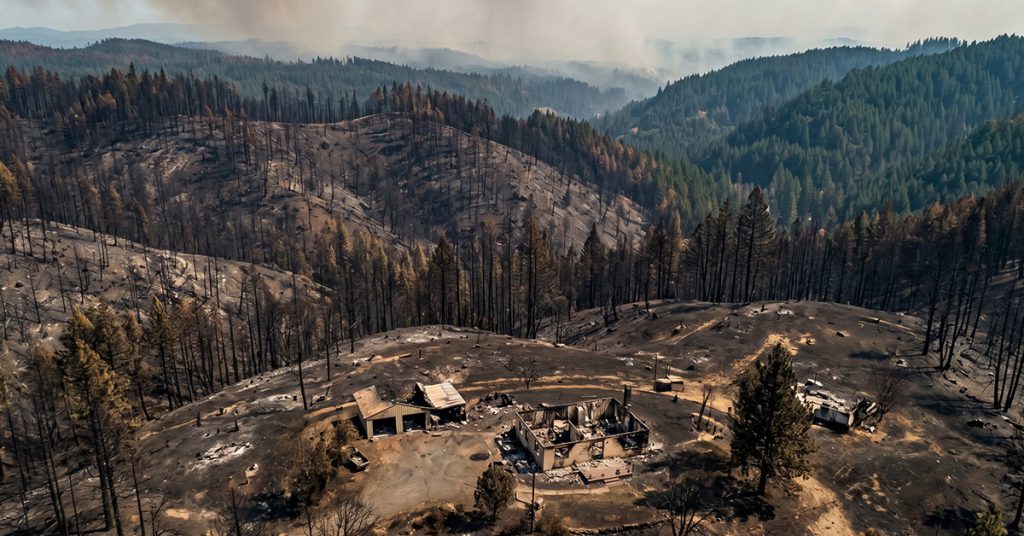
A class action lawsuit arising from major wildfires that occurred in Oregon around Labor Day 2020 was remanded back to trial court due to errors in juror instruction. The plaintiffs in this case, property owners and others affected alleged that PacifiCorp, an electric utility company, caused or contributed to several fires through negligent operation of its power infrastructure.
Case Background and Claims
The lawsuit involved four major wildfires: the 242 Fire, Echo Mountain Complex Fire, South Obenchain Fire, and Santiam Canyon Fire. Plaintiffs claimed PacifiCorp failed to take reasonable safety measures, including failing to clear vegetation near power lines, not shutting off power during dangerous wind conditions, and failing to monitor weather risks adequately. The class action suit included over 2,000 property owners whose land or property was damaged within the burn areas of these fires.
The case was certified as a class action and divided into two phases. Phase I determined liability and damages for named plaintiffs, while Phase II would address damages for other class members.
Plaintiffs’ Theories of Causation
For three fires, plaintiffs argued a single ignition caused by PacifiCorp started each fire, using a “but-for” causation standard. For the Santiam Canyon Fire, plaintiffs argued multiple PacifiCorp-caused fires contributed and used a “substantial factor” standard, including claims that fires forced firefighters to evacuate, allowing another fire to spread.
Appellate Court Decision
While a jury initially found PacifiCorp liable, the Oregon Court of Appeals has since overturned that verdict. The reversal hinged on a critical procedural error regarding jury instructions.
The trial court had instructed the jury that it could assume evidence presented by the named plaintiffs applied globally to all class members. PacifiCorp challenged this, arguing that the instruction was prejudicial and incorrect because it allowed the jury to generalize evidence across different plaintiffs and fires. They argued that such a “broad brush” approach bypassed the requirement to prove causation for each individual property owner. They pointed out that “the jury needed to consider four different sets of liability and causation evidence applicable to the four different fire areas within the class boundary.” They argued that even within each of the fire zones there was substantial variation. They argued that the jury instruction deprived PacificCorp of its due process right to present each individual defense.
The appellate court agreed with PacifiCorp, ruling the jury instruction was legally incorrect and prejudicial. Therefore, the court reversed the judgment and remanded the case for back to Multnomah County Circuit Court. This vacated the previous liability judgement and sends the parties back to the trial level to address the evidentiary gaps identified by the higher court.
This remand creates a significant “logjam” in the judicial process for the fire victims. While it does not absolve the utility of the underlying negligence claims, it necessitates a more rigorous and prolonged process for establishing individual causation. For the victims, this represents a major procedural hurdle that delays final resolution while the trial court determines how to re-litigate these issues under the stricter standards mandated by the Court of Appeals.
