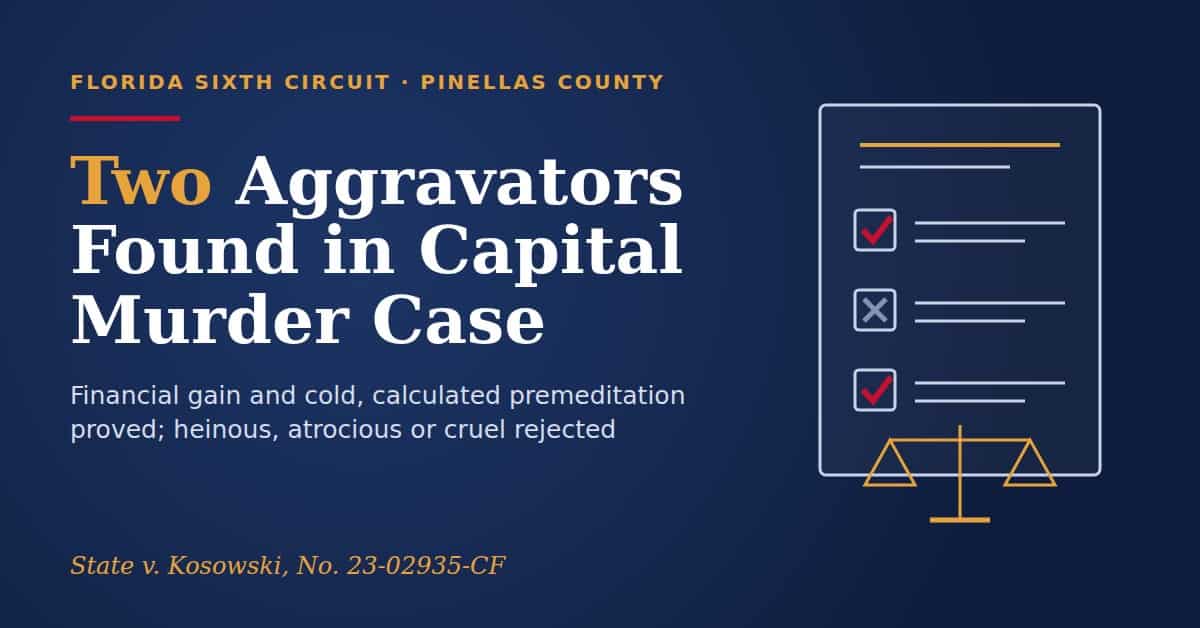
Tomasz Kosowski, who represented himself, received a death sentence after prosecutors cited two aggravating factors and court-appointed counsel presented mitigation in Pinellas County Circuit Court.
Circuit Court of the 6th Judicial Circuit in and for Pinellas County, Florida | No. 23-02935-CF | State’s Memorandum of Law for Sentencing and Independent Special Counsel’s Sentencing Memorandum filed Oct. 7, 2026
A Pinellas County judge sentenced Tomasz R. Kosowski to death on Nov. 20 for the first-degree murder of attorney Steven Cozzi, according to reports by the ABA Journal and the Tampa Bay Times. The ABA Journal identified the judge as Pinellas County Circuit Judge Joseph A. Bulone.
The sentence followed competing memoranda filed Oct. 7. Prosecutors argued that two aggravating circumstances the court had already found “far outweigh” the mitigating ones. A court-appointed independent special counsel set out mitigating information for Kosowski, who represented himself and, according to that filing, declined to present mitigation or argue for or against a death sentence. Both memoranda were filed ahead of a sentencing proceeding known as a Spencer hearing, scheduled for Oct. 8.
How the case reached sentencing
According to the special counsel’s memorandum, the court granted Kosowski’s request to represent himself on Aug. 6 after a Faretta hearing, and he waived a jury for both the guilt and penalty phases on Aug. 31. A bench trial began Sept. 14 and ended Sept. 23, when the court found him guilty of first-degree premeditated murder as charged, the memorandum says.
The penalty phase began the same day. The special counsel’s filing says the court, acting as fact-finder, found that the state proved two of its three asserted aggravating factors beyond a reasonable doubt: that the murder was committed for financial gain, and that it was committed in a cold, calculated and premeditated manner without any pretense of moral or legal justification. The court did not find that the state proved the murder was especially heinous, atrocious or cruel, according to the filing.
Because Kosowski said he would offer no mitigation, the court appointed attorney John Nohlgren as independent special counsel to present any available mitigating information, the memorandum says.
Prosecutors’ case for a death sentence
The state’s memorandum, filed by State Attorney Bruce Bartlett’s office, ties the killing to a civil lawsuit Kosowski filed in May 2019 against several medical businesses and individuals, seeking damages in excess of $15,000. Cozzi, an associate at the Blanchard Law Firm, was lead attorney for most of the defendants, the memorandum says. Kosowski began representing himself in that suit after his lawyer withdrew in March 2022, according to the filing.
Citing trial testimony from Jake Pillsbury, a lawyer for another defendant, prosecutors describe the litigation as contentious and say Kosowski filed pleadings seeking sanctions against Cozzi and his removal from the case. Cozzi moved for summary judgment in October 2022, and the motion was set to be heard in May 2023, the memorandum says.
On March 21, 2023, according to the state, trial evidence showed Cozzi left his office at about 9:50 a.m., shortly before a telephonic hearing in the civil case, and was never seen again. Prosecutors say Kosowski killed Cozzi in a men’s bathroom at the firm’s Largo building between 9:50 a.m. and 10:22 a.m., then called into the hearing from the parking lot at about 10:28 a.m.
On pecuniary gain, the state argues the evidence shows Kosowski was “motivated, at least in part, by a desire to obtain money, property, or other financial gain,” and asks the court to give that factor great weight.
On the second factor, prosecutors contend Kosowski “systematically and methodically planned, prepared, surveilled, researched, purchased items, and laid in wait on the day of the homicide.” The memorandum asserts the premeditation could span as many as 99 days, starting Dec. 12, 2022, when prosecutors say he began negotiating for a Toyota Tundra he never registered. Prosecutors also cite what they describe as online searches for personal information about Cozzi, visits to the law firm’s building without a legitimate purpose, and searches about the drug succinylcholine the day before the killing. The state asks that this factor receive “extremely great weight.”
Prosecutors concede Kosowski has no prior criminal history but argue that circumstance, along with his education, work history and jail conduct, deserves little weight. His medical training and “his misuse of it,” the state argues, are “the opposite of a mitigator.”
Mitigation presented by special counsel
Nohlgren’s memorandum argues the available mitigating evidence “should be taken with great weight.” It identifies one statutory mitigator, the absence of any prior arrests or convictions, and several nonstatutory ones.
The filing says Kosowski was born in Poland in 1979, that his family left for West Berlin as refugees in about 1982 and that a Kansas church group sponsored their move to the United States in 1986. It lists degrees from the University of New Mexico, a medical degree and MBA from Dartmouth, work as a plastic surgeon in Florida and published medical research.
The memorandum describes “remarkably good jail conduct” over nearly three and a half years in the Pinellas County Jail, citing 10 incident reports, four of which refer to alleged misconduct. It says no notice of mental health mitigation was filed. It also argues Kosowski could be “a teacher, a peacemaker, and a leader” in prison.
Special counsel further urges the court to compare the case with other Pinellas County capital cases, summarizing three in which defendants initially sentenced to death ultimately received life without the possibility of parole.
Limits of the filings
Both memoranda are advocacy. The state’s account of the trial evidence is prosecutors’ characterization, and the special counsel’s filing says Kosowski himself made no argument for or against the death penalty. The state’s memorandum acknowledges that the weight given to each mitigating factor rests within the trial court’s discretion.
Takeaways
Kosowski was sentenced to death Nov. 20, according to the ABA Journal and the Tampa Bay Times. Prosecutors had sought that sentence based on two aggravating factors the judge found after a bench trial: pecuniary gain and a cold, calculated and premeditated killing. The judge declined to find a third, according to the special counsel’s memorandum.
Kosowski represented himself and, according to the special counsel, offered no mitigation. The mitigation case therefore came from a court-appointed independent special counsel.
The state conceded the absence of prior criminal history but argued it and the other mitigation deserved little weight. The special counsel argued the mitigation deserved great weight and pointed to other Pinellas County capital cases that ended in life sentences.
The memoranda are advocacy, not rulings. How the judge weighed each aggravating and mitigating factor would be set out in the sentencing order.