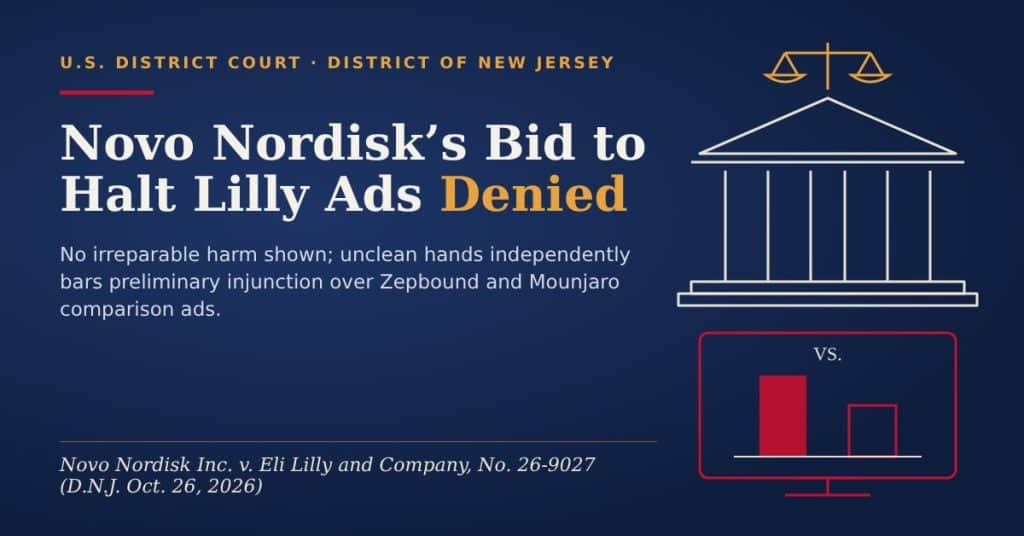
A New Jersey federal court found Novo had not shown irreparable harm and that its own past comparative advertising independently barred equitable relief under the unclean hands doctrine.
A federal judge in New Jersey on Oct. 26 refused to stop Eli Lilly and Company from running advertisements that compare its weight-loss and diabetes drugs with Novo Nordisk’s, ruling that Novo had not shown the ads were causing it irreparable harm and that Novo’s own similar advertising history separately weighed against relief.
U.S. District Judge Zahid N. Quraishi denied Novo Nordisk Inc.’s motion for a preliminary injunction in Novo Nordisk Inc. v. Eli Lilly and Company, Civil Action No. 26-9027, in the U.S. District Court for the District of New Jersey. The opinion is designated as not for publication. A one-page order entered the same day also lifted a stay of Lilly’s deadline to respond to the complaint.
The dispute
Novo sued Eli Lilly and Company and Lilly USA, LLC on July 21, 2026, alleging false advertising and unfair competition under the Lanham Act and unfair competition under New Jersey law. Three days later, Novo moved for a preliminary injunction that would have halted the ads and required Lilly to run corrective advertising.
The challenged ads rely on two Lilly-sponsored head-to-head clinical trials. Television, website and social media ads for Zepbound (tirzepatide) cite SURMOUNT-5, in which participants taking Zepbound 10 mg or 15 mg lost an average of 20.2% of their body weight, about 50 pounds, compared with 13.7%, about 33 pounds, for participants taking Novo’s Wegovy (semaglutide) at 1.7 mg or 2.4 mg. A Mounjaro commercial cites SURPASS-2, reporting a 2.3% reduction in A1c for Mounjaro 15 mg compared with 1.9% for Ozempic 1 mg.
Novo’s central argument was that the ads mislead consumers because neither trial tested the highest doses of Novo’s drugs now on the market. The Food and Drug Administration approved Wegovy 7.2 mg in March 2026 based on Novo’s STEP UP trial, and approved Ozempic 2 mg in 2022. The opinion also notes that both Lilly trials were open-label, a design the FDA has criticized when used to support comparative superiority claims.
After Novo objected in an April 22 letter, Lilly revised the Zepbound ad to specify that the comparison involved Wegovy doses up to 2.4 mg and added a disclosure that Wegovy 7.2 mg was not evaluated in the study and has since been approved. The Mounjaro commercial carried a small-print note that Ozempic 2 mg was not available at the time of the study.
Two-day evidentiary hearing
The court held an evidentiary hearing on Aug. 27 and 28 at which 12 witnesses, six for each side, testified in person, including company executives and survey experts. The judge found nearly all of them credible but gave “low credibility” to the testimony of Derrick Gastineau, Novo’s U.S. brand leader for Wegovy, describing it as conflicting, contradictory and evasive.
No showing of irreparable harm
The decision rested chiefly on irreparable harm, one of two “gateway” requirements for preliminary relief. Judge Quraishi wrote that Novo offered only speculative assertions that the ads threatened its future sales and goodwill, without supporting evidence. Gastineau testified that the damage to Novo’s goodwill was nearly impossible to quantify, but on cross-examination he acknowledged that Novo values its goodwill each year in its annual report, according to the opinion. The court also noted that although Novo conducts ongoing market research, Gastineau attached none of it to his declaration.
Lilly, by contrast, presented testimony from its chief financial officer, Mark Stempel, who summarized data from a health care analytics provider showing that prescriptions for Novo’s products remained stable from April through July 2026, while the challenged ads ran. The court further found that Novo had not demonstrated that any nontrivial harm it might suffer could not be remedied through monetary damages.
The judge also addressed the Trademark Modernization Act of 2020, which gives Lanham Act plaintiffs a rebuttable presumption of irreparable harm once they show a likely success on the merits. Even assuming Novo qualified for the presumption, the court found that Lilly’s prescription data, Novo’s delay in filing suit, and Novo’s own goodwill valuation were enough to rebut it.
Unclean hands
As an independent ground for denying the preliminary injunction, the court found Lilly’s unclean hands argument persuasive and said it would also exercise its discretion to deny relief based on Novo’s own comparable advertising practices. According to the opinion, after Lilly won FDA approval for higher doses of its diabetes drug Trulicity, Novo continued making superiority claims based on its own SUSTAIN-7 trial without disclosing that higher Trulicity doses were available or untested. Novo conceded it stopped those ads only days before filing this lawsuit, the court said.
The judge rejected Novo’s efforts to distinguish its conduct based on changes in the GLP-1 market and differences in advertising venues, concluding that Novo had used “a nearly identical advertising strategy.”
A preliminary look at the merits
At the request of Novo’s counsel, the court offered a brief and expressly preliminary view of the merits, calling Novo’s case “less than persuasive” on the limited record. The judge noted that Novo conceded the ads contain no actual misrepresentations and that they disclose the untested Wegovy dose; that Lilly’s critiques of Novo’s consumer-survey designs raised doubts about the surveys’ value; and that Novo’s theory appeared to overlook the role prescribing physicians play in a patient’s choice of GLP-1 medication.
Those observations are not a final ruling on the merits. Novo’s Lanham Act and New Jersey claims remain pending, and Lilly must now respond to the complaint.
Read the full opinion and order: Novo Nordisk Inc. v. Eli Lilly and Company, No. 26-9027 — U.S. District Court (D.N.J.) Opinion (Oct. 26, 2026) and Novo Nordisk Inc. v. Eli Lilly and Company, No. 26-9027 — U.S. District Court (D.N.J.) Order (Oct. 26, 2026).
By The Trial Attorneys Editorial Staff
The information contained in this publication is provided for general informational and educational purposes only and is not intended to constitute legal advice, nor should it be relied upon as such.